Screw Conveyor: Industrial Applications and Design Guide
Explore the benefits of screw conveyors in bulk material handling across food, chemical, agriculture, and manufacturing industries.
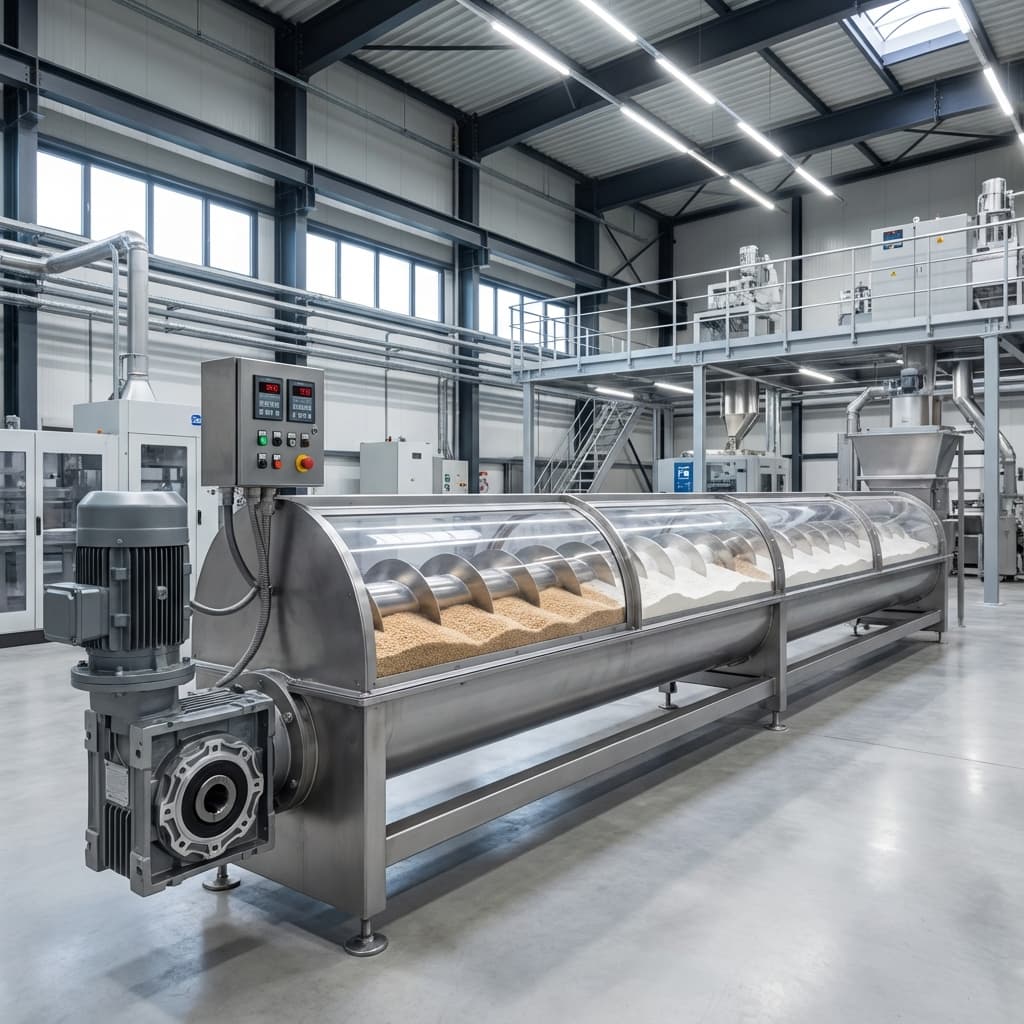
What is a Screw Conveyor?
Screw conveyors are industrial machines designed for the efficient transportation of bulk materials, including granular solids, powders, pellets, flakes, semi-solids, and even liquids, by means of a rotating helical screw blade within a stationary trough or tube. This mechanism propels the material forward, eliminating the need for manual handling and improving operational efficiency.
They are a cost-effective and versatile solution for material handling, offering enclosed transportation for dusty, hazardous, or corrosive environments. The adaptability of screw conveyors, through various designs and material handling capabilities, makes them an indispensable tool in modern industrial processes for efficient and controlled bulk material movement.
Key Specifications
Technical Specifications
Load Capacity
1–50 m³/hr (customizable)
Conveyor Diameter
100–600 mm
Conveyor Length
Customizable per layout
Inclination Angle
0–30° (up to 45° for inclined models)
Motor Power
0.5–15 kW
Speed
10–100 RPM
Material
Mild Steel / Stainless Steel / Carbon Steel
Drive Type
Electric Motor / Gear Motor
The screw diameter should be at least 1.5 times the maximum lump size for sized material and four times for unsized material. Pitch usually ranges from 0.75 to 1 times the diameter. Materials of construction are chosen based on the conveyed material—stainless steel is preferred for hygienic and corrosive applications (food, pharmaceutical, chemical), while abrasion-resistant steel is used for highly abrasive materials.
Types of Screw Conveyors
1. Horizontal Screw Conveyors
The most common type, used to move bulk materials between processes. They are available in a wide range of sizes, lengths, and materials, making them versatile for various applications.
Best For: General material transfer, process-to-process movement, horizontal transport applications
2. Inclined Screw Conveyors
Transfer materials at an angle, typically from slightly above horizontal up to 45 degrees. As the angle of inclination increases, conveying efficiency and load capacity decrease, requiring more power due to gravity and material fallback.
Best For: Elevating materials between different floor levels, space-constrained facilities
3. Vertical Screw Conveyors
Transport materials on vertical paths, providing a space-saving and cost-effective method for elevating powders or granular materials. They can elevate materials up to 30 feet without internal bearings.
Best For: Vertical elevation, space-saving installations, powder and granular materials
4. Shaftless Screw Conveyors
Lack a central shaft, making them ideal for handling sticky, wet, viscous, or stringy materials like industrial sludge and biosolids, as they prevent material buildup and eliminate the need for internal bearings.
Best For: Sticky materials, wastewater treatment, sludge handling, biosolids
5. U-Trough Screw Conveyors
Characterized by their U-shaped trough, this is a common design for various bulk materials. The U-trough design provides easy access for maintenance and cleaning.
Best For: General bulk material handling, easy maintenance requirements, standard applications
6. Tubular Screw Conveyors
Enclose the screw in a round tube, offering protection against environmental contaminants and suitability for fine powders and fragile materials. The enclosed design prevents dust emissions and contamination.
Best For: Fine powders, fragile materials, dust-sensitive environments, food processing
Applications and Industries
Screw conveyors are vital across a multitude of industries for transporting a wide array of bulk materials:
Agriculture & Grain Handling
Moving grains, seeds, animal feed, fertilizers, and other agricultural products between storage, processing, and packaging.
Materials: Wheat, corn, rice, soybeans, animal feed
Food Processing
Hygienic transport of dry ingredients such as flour, sugar, coffee, spices, cocoa, and cereal grains. Stainless steel conveyors are crucial for sanitation.
Materials: Flour, sugar, coffee, spices, cocoa, cereals
Chemical & Pharmaceutical
Safely handling powders, granules, corrosive chemicals, and hazardous materials, with enclosed and often stainless steel designs to ensure purity.
Materials: Chemical powders, pharmaceutical ingredients, additives
Mining & Minerals
Transporting ores, coal, ash, sand, gravel, aggregates, limestone, and other minerals in processing plants and construction sites.
Materials: Coal, ash, sand, gravel, limestone, minerals
Construction Materials
Moving cement, sand, lime, fly ash, plaster, and aggregates for concrete production and other building processes.
Materials: Cement, sand, lime, fly ash, plaster
Wastewater Treatment
Handling sludge, biosolids, and chemical additives in treatment facilities. Shaftless designs are particularly effective.
Materials: Sludge, biosolids, chemical additives
Plastics & Polymers
Moving plastic granules, resin pellets, and powdered additives in manufacturing processes.
Materials: Plastic granules, resin pellets, additives
Biomass & Energy
Handling wood pellets, bio-waste, and other organic materials for energy production.
Materials: Wood pellets, bio-waste, organic materials
Design Considerations
Material Characteristics
Critical factors include particle size, lump size, bulk density, flowability, abrasiveness, corrosiveness, flammability, and moisture content. Lighter, free-flowing, and non-abrasive materials can tolerate higher trough loading (up to 45%), while denser, sluggish, or extremely abrasive materials require lower trough loading (15-30%) to reduce wear.
Capacity Requirements
Typically measured in cubic feet per hour, capacity is influenced by screw diameter, pitch, rotational speed, loading efficiency, and angle of inclination. Larger screws and higher speeds generally increase capacity.
Trough Loading
Refers to the percentage of the trough filled with material, impacting efficiency and wear. Proper trough loading is essential for optimal performance and component longevity.
Drive Unit Placement
Typically recommended at the discharge end. This configuration pulls the material, putting the screw sections in tension and thereby reducing wear and fatigue on components.
Enclosed Design
Common for preventing contamination, containing dust, and safely handling hazardous or corrosive substances. Essential for food, pharmaceutical, and chemical applications.
Safety Features
- •Emergency Stop: Immediate shutdown capability for safety
- •Guarding: Protective covers to prevent access to moving parts
- •Overload Protection: Prevents damage from excessive loads
- •VFD Speed Control: Variable frequency drive for precise speed control
- •Enclosed Design: Prevents dust emissions and contamination
Conclusion
Screw conveyors are versatile, cost-effective solutions for bulk material handling across numerous industries. Their ability to handle diverse materials—from fine powders to granular solids, and even sticky or viscous substances—makes them indispensable in modern industrial operations.
Selecting the right screw conveyor depends on material characteristics, capacity requirements, available space, and industry-specific regulations. Whether you need horizontal, inclined, vertical, or shaftless designs, proper specification and design ensure optimal performance, longevity, and safety in your material handling operations.
Need Expert Guidance on Screw Conveyors?
Our team can help you design and select the perfect screw conveyor system for your specific material handling needs.
Contact Our Experts